Is higher HRV always better?
Not automatically. In general it is associated with better adaptability, but age, context, method and trend all matter.
Pulse tells you how many times the heart beats per minute. Variability describes how intervals change from beat to beat. Strictly, HRV comes from ECG R–R intervals; MaxPulse senses the optical pulse wave and therefore estimates pulse rate variability (PRV). Some metrics may agree at rest, but the two are not automatically interchangeable. Neither HRV nor PRV is a magic health or performance score.
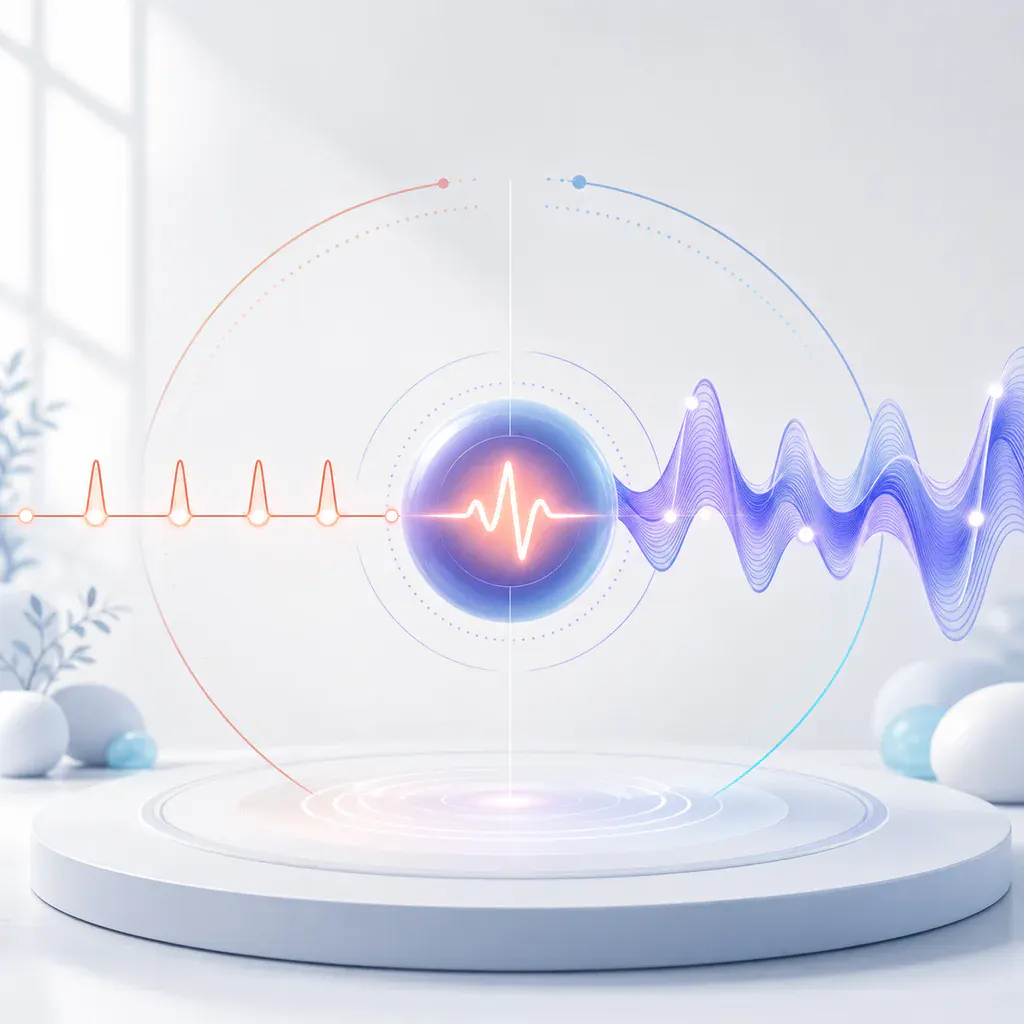
Two people can have the same pulse and a very different HRV. A heart at rest is not perfectly metronomic. The natural variation between beats is exactly what HRV describes, which is why it adds something that heart rate alone cannot tell you.
That makes HRV useful when the question is less about simple rate and more about regulatory state. Pulse is still valuable, but it does not show as much about how the body is handling stress and recovery.
HRV is closely linked with the autonomic nervous system. Higher parasympathetic influence is often associated with greater beat-to-beat variability, while stronger sympathetic strain often lowers it. That does not make HRV a simple good-versus-bad switch.
In practice, HRV fits well into questions about stress load, sleep, recovery, fatigue and whether the body is returning to a calmer state after strain.
Sleep, alcohol, caffeine, illness, dehydration, acute psychological stress, hard training and restless measurement conditions can all change HRV. Time of day and breathing pattern matter too.
That is why one low HRV reading should not be read automatically as disease or burnout. It may simply reflect a demanding day. A repeated weaker trend is much more useful than one isolated drop.
ECG‑HRV from electrical R–R intervals and PPG‑PRV from peripheral pulse intervals are not automatically interchangeable. Pulse transit adds vascular and haemodynamic influences, while systems also differ in algorithms, recording length and artefact handling. A watch or ring can be useful for its own trend, but its values should not be compared one-to-one with MaxPulse or clinical ECG.
That is where Max Pulse is practical: it offers a more standardized short resting snapshot that is easier to repeat under similar conditions. It still does not replace medical assessment, ECG or symptom-based care.
The most useful way to use HRV is repeated testing under similar conditions. One number is a snapshot; a series of measurements shows whether stress load is rising, recovery is improving or the body is failing to return to baseline.
That is where Max Pulse adds value: not as diagnosis, but as a way to follow a regulatory layer next to body composition, blood pressure and subjective feeling.
Low or variable HRV does not diagnose a condition on its own. If it sits next to chest pain, shortness of breath, repeated palpitations, fainting, known arrhythmia or an unusually abnormal resting pulse, the next step is proper medical follow-up rather than another wellness interpretation.
HRV also cannot by itself confirm burnout, depression or overtraining. It can contribute one useful layer, but not the whole answer.
About the measurement
The main page about HRV, vascular signal, stress and autonomic balance.
FAQ
Not automatically. In general it is associated with better adaptability, but age, context, method and trend all matter.
Yes. That is exactly why HRV is useful. The same pulse does not always mean the same regulatory state.
Usually not directly. Different systems use different sensors and methods, so it is more useful to follow trend within one system than compare absolute values across devices.
No. Low HRV can reflect stress, fatigue, illness or poor recovery, but it does not make a diagnosis on its own. Trend, context and symptoms matter.
MaxPulse adds PPG‑PRV and proprietary regulatory categories to the visit. It is most useful as a within-device trend, not as an ECG examination or isolated verdict.