Is a smart scale useless then?
No. It can be useful for frequent weight tracking and a rough home trend. The key is to understand that calculated body fat, muscle or visceral fat values are not as robust as a more detailed professional test.
A home smart scale and an InBody device may both use bioelectrical impedance, but they are not the same tool. A smart scale is best for frequent weight tracking and a rough home estimate, while a professional InBody test uses more segments, frequencies, electrodes and a more controlled procedure. That is why fat, muscle and water values often do not match number for number.
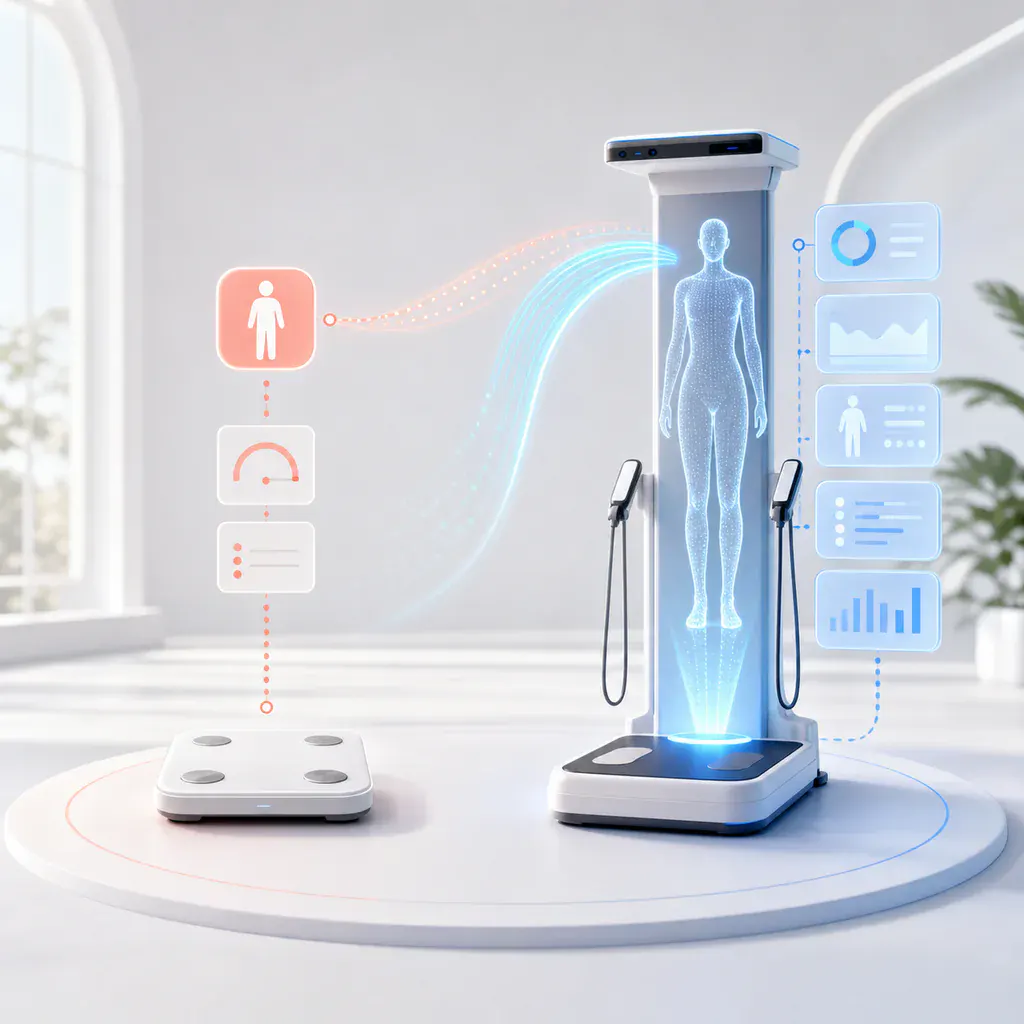
If you mainly need the practical difference between a home smart scale and a professional InBody test, this table gives the short version first. The details are explained below.
| Area | Smart scale | InBody 970 / 970S |
|---|---|---|
| Best use | Home routine and broad direction. | Professional checkpoint with a more detailed output. |
| Measurement setup | Often mainly foot-to-foot, with much of the body estimated by algorithm. | Hand and foot electrodes with segmental multi-frequency measurement. |
| Output | Body weight plus rough estimates of fat, muscle and body water. | Muscle, fat, water, segmental values, ECW/TBW, visceral fat context and more. |
| Main strength | Frequent home weigh-ins with minimal friction. | Better context for body-composition change and repeat-visit trends. |
| Main limitation | More noise in calculated values beyond body weight itself. | Still an estimate that depends on preparation and conditions. |
A consumer smart scale is practical for a home routine: you step on it, get your weight quickly and the app estimates additional body composition values. Many models measure mainly through the feet, so they directly measure only part of the body and estimate the rest through a proprietary algorithm.
InBody uses hand and foot electrodes, segmental measurement and multiple frequencies. It can work separately with the legs, arms and trunk, then provide a broader context such as skeletal muscle mass, body water, ECW/TBW, segmental analysis and visceral fat context.
This does not mean InBody is a medical diagnosis or that a smart scale is useless. It means you are comparing a simpler home estimate with a more detailed professional measurement. Different numbers are expected.
Bioelectrical impedance directly measures the body resistance to a small electrical current. Fat, muscle and water values are calculated from that signal rather than weighed as separate tissues. The result depends on hardware, frequencies, electrode placement, algorithm design, user inputs such as age and height, and the population used to build the model.
With smart scales, body weight is often the most usable value. Body fat, lean mass, muscle estimates or visceral fat are more likely to be rough orientation. A study comparing several commercial smart scales with DXA found that weight measurement could be close, while fat mass and lean mass estimates showed larger errors.
Conditions also matter. Morning after bathroom use is not the same as evening after training. Salt, alcohol, carbohydrates, fluid intake and recent exercise can change body water distribution. In BIA, that can shift not only water outputs but also calculated fat and muscle values.
Neither InBody nor a smart scale physically separates the body into fat, muscle and water. Both systems measure impedance and calculate body composition. The difference is how much signal they collect, how well they separate body segments and how standardized the testing process is.
For that reason, it is risky to create a simple rule such as "my smart scale is always four percentage points higher". The difference may not stay the same across body fat, muscle, hydration status, training phases, weight change or even software updates in the scale app.
A better question is whether you are tracking the same device under similar conditions and seeing a stable long-term direction. If yes, a home scale can support routine. If you need to understand where the change is happening, a professional test is more useful.
A home scale is useful when you want to track weight frequently, maintain a simple routine and watch a broad direction over time. Use it at the same time of day, in the same place, ideally in the morning after bathroom use and before food.
Treat values such as body fat, muscle, body water or metabolic age as directional signals. If body fat jumps sharply in one day but your weight, routine and body do not match that size of change, it is probably measurement noise rather than a real tissue change.
A smart scale works best when it is not treated as a daily verdict. Look at weekly or monthly direction and avoid comparing percentages directly across different brands, apps and devices.
InBody makes more sense when you are actively working on fat loss, muscle gain, recomposition or return to training and want to separate weight change from body composition change. It is also more useful when segmental balance, body water context or a structured result sheet matters.
The advantage is not just a longer list of numbers. The output connects weight, skeletal muscle mass, body fat, water, segmental values and history in one place. That gives better context for a consultation and for deciding what to track next.
One test is still not a diagnosis or a complete medical assessment. If unexpected values repeat, or if you have swelling, marked weakness, rapid unexplained weight change or symptoms, discuss the situation with a qualified healthcare professional.
The cleanest approach is to use a home scale for frequent routine and InBody as a more detailed checkpoint every few weeks. Do not try to explain every daily smart-scale fluctuation through an InBody result, and do not compare values if the testing conditions were different.
If a home scale shows weight moving down but InBody later suggests that muscle is also dropping, that is useful context for reviewing training, recovery, energy intake or protein. If weight is stable but InBody shows less fat and more muscle, that may be a body recomposition that body weight alone does not show.
Choose one main source for each question: smart scale for frequent weight, InBody for more detailed body composition and trend between visits. This reduces the risk of reacting to noise instead of a real change.
About the measurement
The main page about body composition measurement, result output and the visit.
Values explained
More reading
FAQ
No. It can be useful for frequent weight tracking and a rough home trend. The key is to understand that calculated body fat, muscle or visceral fat values are not as robust as a more detailed professional test.
If you need more detailed body composition, segmental information, water context and a result that can be discussed in a structured way, InBody is usually the better tool. A smart scale is better for simple routine.
Usually because the measurement path, electrodes, frequencies, algorithms and test conditions are different. A foot-to-foot scale often estimates much of the body indirectly, while InBody measures more segments separately.
Not necessarily. Use it for a different job: frequent body-weight routine and rough direction. Use InBody for a more detailed body composition checkpoint over a longer interval.
InBody is more useful when you want muscle, fat, body water and segmental context rather than just a quick consumer estimate.