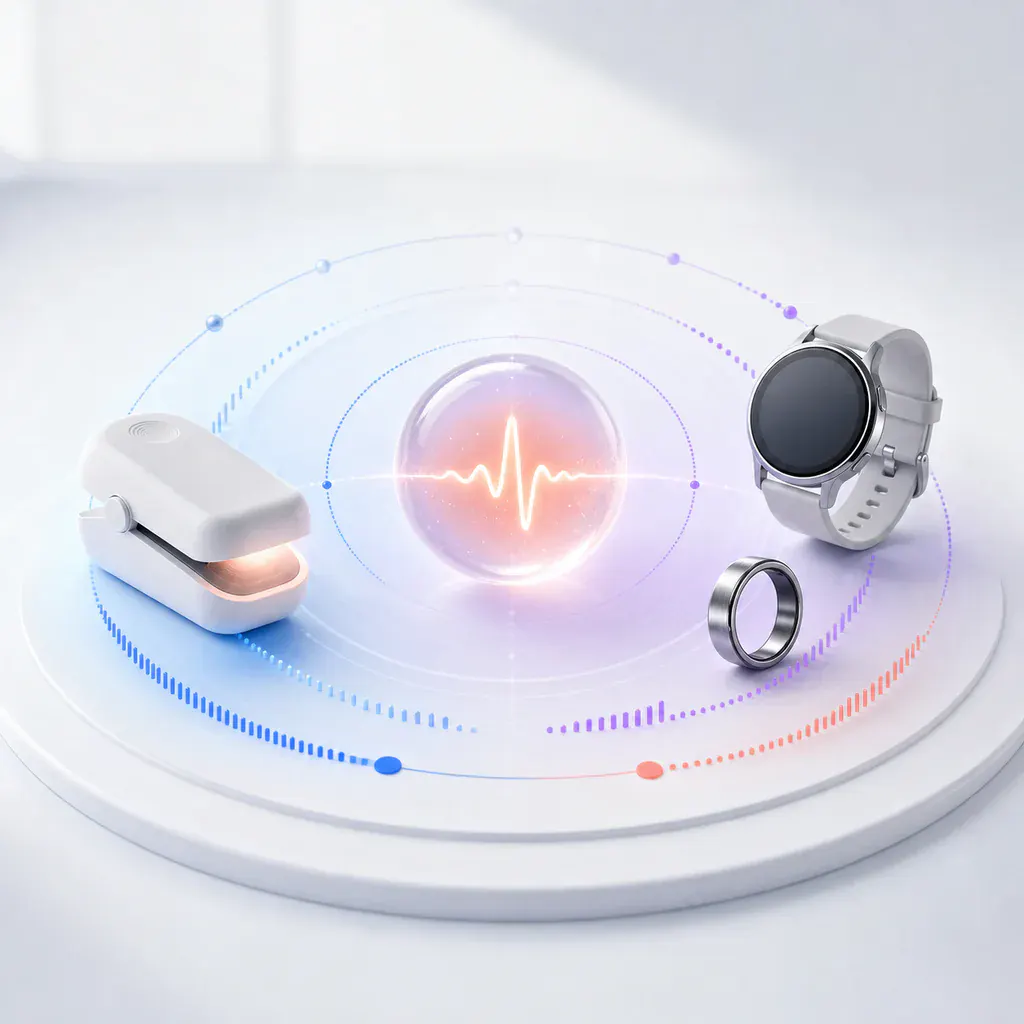
Heart rate variability (HRV) reflects how much the intervals between individual heartbeats differ – the more flexible your autonomic nervous system, the greater this variability tends to be at rest. Both Max Pulse and consumer wearables estimate HRV, but each takes a different approach: the sensor, the measurement window, and what gets calculated from the raw data all differ.
So "which is more accurate" doesn't have a single answer. Wearables like Oura, Whoop, Garmin, or Apple Watch collect data passively through the night, and their main value lies in how the number shifts week to week – not in any single isolated reading. Max Pulse, by contrast, takes a short, standardized resting measurement on site under defined conditions, and adds a vascular pulse-wave component (APG) that no consumer wearable currently provides.
On top of that, wearables themselves aren't uniformly accurate. Independent validation studies comparing overnight HRV against clinical ECG references show that accuracy varies noticeably between brands and models. That means even two wearables can disagree with each other, let alone with an on-site measurement like Max Pulse.