

13 min readAuthor: MojeInBodyUpdated

How to Measure Your Waist and Waist-to-Height Ratio (WHtR)

Using the WHO and NICE method described here, measure your waist midway between the lower edge of the last palpable rib and the top of the hip bone. Keep the tape horizontal, without compressing the skin, and read it after a natural exhale. Calculate waist-to-height ratio (WHtR) by dividing waist by height in the same units. It supports assessment of central fat and risk; it is not a diagnosis or a certificate of health.

A measuring tape used to track waist circumference

What Does Waist Circumference Add to Weight and BMI?

Body weight describes total mass, while BMI relates it to height. Waist circumference adds a different question: how large is the abdomen around a precisely defined line? It is used as an indirect indicator of central fat storage. It does not separate fat under the skin from fat around the organs or tell you how much muscle you have.

For home tracking, repeatability is the main benefit. If you measure the narrowest part of your trunk once and your navel level next time, the difference may not reflect a body change. Choose a method and record it before interpreting centimetres. This guide uses the anatomical midpoint specified by WHO and NICE.

Waist circumference contributes to a wider assessment including health history, blood pressure, laboratory results where appropriate and body composition. A favourable waist cannot rule out high blood pressure or another health problem. Our separate comparison of BMI, fat and muscle explains the difference between weight and composition.

Where to Measure: Find Two Anatomical Landmarks

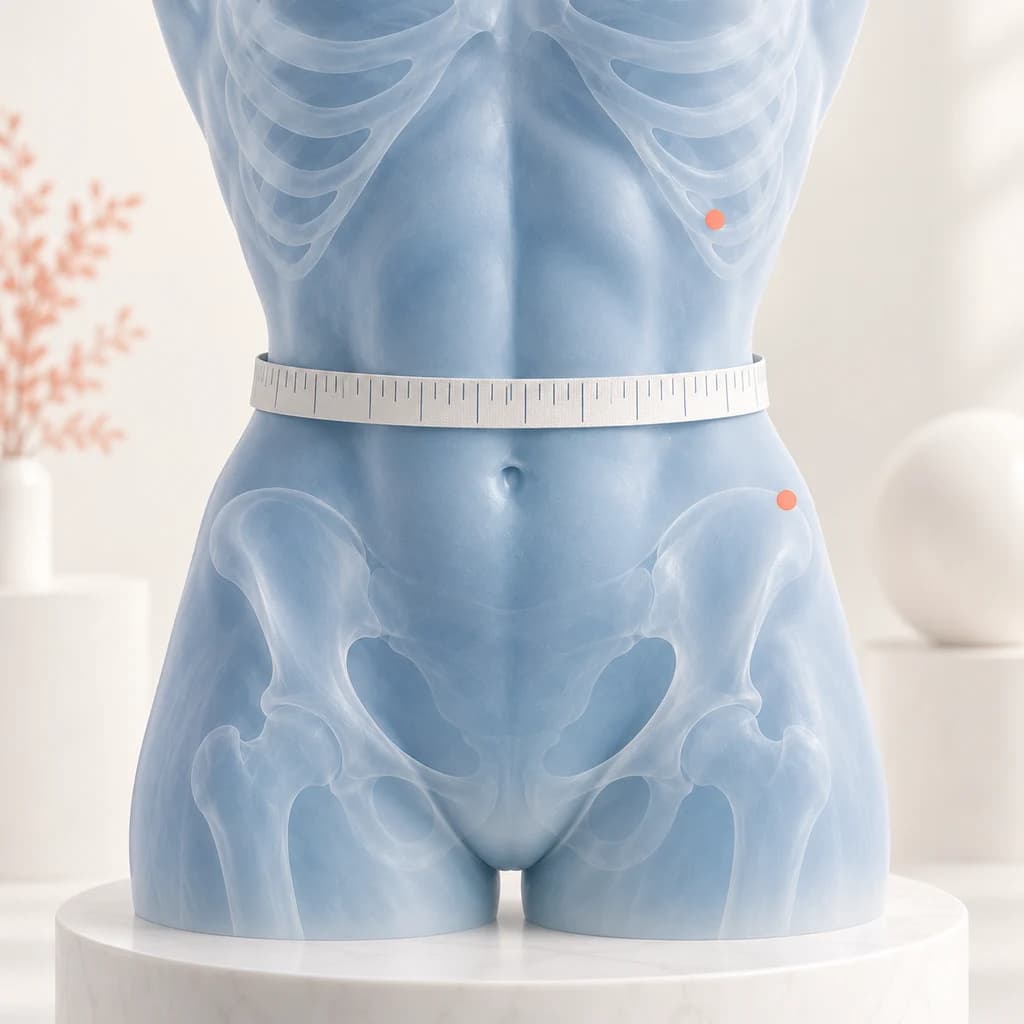
On the side of your trunk, feel for the lower edge of the last palpable rib and the top of the hip bone, or iliac crest. The measurement line sits halfway along the vertical distance between them. Locate the corresponding point on the other side and wrap the tape around at that level. This is not your hip circumference or the top of your trousers.

Your belly button may help you orient yourself, but it does not define this method: its position relative to the bony landmarks varies between people. Do not search for the narrowest part of the trunk instead. Other protocols exist, including measurement at the top of the iliac crest. Their readings cannot automatically be joined into one history.

If you cannot confidently find the landmarks or keep the tape level, ask for help. A healthcare professional can show you the position and record the protocol. If a clinic result differs from yours, compare the location and procedure first; the difference alone does not prove either reading is wrong.

Torso diagram marking the lower edge of the last palpable rib, the top of the hip bone and a tape line halfway between them.

WHO/NICE method: anatomical landmarks define the line. Keep the tape horizontal without compressing skin; the navel is not a universal measurement point.

View the full-size diagram

Measure Your Waist Step by Step

Prepare a flexible, non-stretch measuring tape, a mirror and a way to record the result. A mirror or another person is especially useful for checking the back of the tape. Avoid bending forward significantly to read it, as this changes your posture and abdominal tension.

For a home trend, keep timing and conditions similar, such as before your usual breakfast. This is not a requirement to fast or change your fluid intake to obtain a smaller number. WHO notes that digestive-tract contents affect circumference; a note about unusual bloating or a large meal helps you interpret the reading.

  • 1. Expose the measurement area. Ideally measure directly on the skin; avoid thick clothing, belts or gathered layers.
  • 2. Stand upright, feet close together and weight evenly distributed. Keep your abdomen relaxed.
  • 3. Find the last rib and top of the hip bone. Identify the midpoint on both sides.
  • 4. Wrap the tape around your trunk at that level. Check that it is horizontal at the front and back and is not twisted.
  • 5. Place it snugly against the skin without pulling it into an indentation or compressing soft tissue.
  • 6. Breathe naturally a few times. Read the circumference after a normal exhale, without sucking in, straining or holding your breath.
  • 7. Record centimetres, date and method. If the tape slipped or you changed posture, repeat the measurement rather than correcting the number by guesswork.

Common Errors: A Smaller Number Is Not Always a Better Reading

The aim is to describe your body under the recorded conditions. Repeatedly tightening the tape or selecting the smallest number from several attempts creates a reading that will be hard to compare next time. If a reading is uncertain, correct the technique rather than the value.

Near an indicative threshold, check whether a difference reflects the body or simply tape placement. One poorly taken home measurement is not a sound basis for a drastic change in routine.

ErrorWhy it mattersWhat to do
Navel once, narrowest point next timeThe measurement line changed.Return to the anatomical midpoint and record the method.
Sloping or twisted tapeIt is not the same horizontal circumference.Check the whole loop in a mirror or with help.
Sucking in or forcing a deep exhaleAbdominal shape and tension changed.Relax and read after a normal exhale.
Tape digging into the skinSoft tissue is compressed.Maintain contact without compression.
Rounding before calculating WHtRIt may move the result across a threshold.Calculate from the recorded values; round only for display.

Calculate WHtR: Waist Circumference Divided by Height

WHtR stands for waist-to-height ratio. The formula is straightforward: WHtR = waist circumference ÷ body height. Both values must use the same unit. Centimetres are a simple choice; the resulting ratio has no unit. It is not your percentage of body fat.

A waist of 84 cm and height of 168 cm give 84 ÷ 168 = 0.50. A waist of 81 cm at the same height gives about 0.482. If you accidentally divide 84 cm by 1.68 metres, the result is 50: that is a unit error, not a health result.

Height explains why the same circumference is not the same ratio. A 90 cm waist gives a ratio of 0.50 at 180 cm tall and 0.5625 at 160 cm tall. This still does not compare two people’s entire health. It simply shows what height adds to this particular indicator.

  • Use a currently verified height, ideally without shoes, rather than a guess from an old document.
  • Keep the original waist and height values. Do not round away a borderline result.
  • WHtR uses height; WHR is a different ratio, waist divided by hip circumference.

Read NICE WHtR Bands in Their Adult Context

NICE recommends adding waist-to-height ratio to BMI in adults with BMI below 35 kg/m². Within that framework, the following classification of central adiposity, or fat storage around the abdomen, applies to both sexes and different ethnic groups, including adults with high muscle mass.

The bands below follow NICE’s numerical classification. The simple message “waist less than half your height” means WHtR below 0.5. It is not a reason to pursue unlimited weight loss or a guarantee of normal blood pressure, glucose, nutrition or fitness. Do not turn this table into an automatic judgement of health.

NICE WHtR bandCentral adiposity interpretationPractical meaning
0.4–0.49 (below 0.5)The band NICE calls healthy central adiposityA more favourable result within this specific framework; broader health assessment still matters.
0.5–0.59 (below 0.6)Increased central adiposity and associated riskCheck the measurement and discuss wider risk factors with a healthcare professional.
0.6 or moreHigh central adiposity and further increased riskA confirmed result warrants professional assessment rather than diagnosis from a tape.
  • A ratio below 0.4 does not automatically receive a better or safer category in this table. The goal is not the lowest possible ratio.
  • At BMI 35 kg/m² or above, do not apply this framework to your results in isolation; discuss assessment with a healthcare professional.
  • This is an adult guide, not an assessment guide for children or pregnancy. With growth or eating disorders, agree an approach with the treating team.

Why Do Waist Thresholds Differ by Sex and Population?

Circumference in centimetres and WHtR are different approaches. Commonly quoted thresholds for waist alone distinguish between sexes: the Czech National Health Information Portal, for example, describes increased metabolic risk above 80 cm in women and 94 cm in men, and greater risk above 88 and 102 cm respectively. These figures should not become a universal diagnosis for every individual.

WHO specifically addresses differences by sex, age and ethnicity, as well as protocol effects. A centimetre threshold from one population may therefore not suit another. WHtR in the NICE framework above adds height and uses shared bands; this does not remove the need for personal history, blood pressure and other risk factors.

If an online table seems to disagree with a clinic result, check whether you are comparing waist circumference, WHtR or WHR, where the thresholds come from and where the waist was measured. Avoid selecting only the indicator that happens to look most favourable.

Keep a Useful Trend Rather Than a Daily Competition

Create a simple home record. Add the method and conditions to the centimetre reading. Keep location, posture, breathing and tape tension consistent. If you change protocols, mark the change and start a new comparable series rather than guessing a conversion for older numbers.

Choose an interval that fits your goal and any professional advice. You do not need several readings a day to track an ordinary routine change. One fluctuation after a different meal or during bloating does not tell you how much fat was gained or lost. A longer direction recorded with the same technique is more useful.

If your waist changes while weight stays stable, that is a reason to consider body composition and function too. The two numbers alone cannot confirm muscle gain, loss of visceral fat or the cause of the change. An honest record is more useful for your next appointment than an adjusted “ideal” reading.

  • Date and approximate measurement time.
  • Waist in cm and current height in cm; WHtR calculated from those readings.
  • Method: midpoint between the last rib and hip bone.
  • A note about unusual bloating, meals or a change in procedure.
  • Keep weight and any InBody outputs separate; preserve the source of each value.

Why an InBody Waist Is Not the Same as a Tape Measurement

Waist circumference among InBody 970 outputs without the additional Yscope module is estimated from body composition. A tape measures the actual circumference at a specific line. The same label and centimetres do not make the two measurements identical. Ask the provider about any additional module and the origin of the reported value.

For your own anthropometric WHtR, use a tape-measured waist and verified height. Keep the InBody estimate alongside it as a separate series. If the numbers disagree, do not overwrite one with the other or average device and tape readings; first check method, data source and conditions.

InBody adds estimates of total fat, muscle-related mass and visceral fat. Visceral-fat area on a result sheet is not a CT or MRI image of the abdomen either. Waist and BIA belong in a context you can follow, but their agreement or disagreement alone cannot establish metabolic health.

What to Do With a Higher Ratio or an Unexplained Change

First check the technique and calculation. A higher WHtR in the adult framework above is a reason to discuss other risk factors with your GP. Bring the original values, not just a rounded ratio. Your clinician can connect the result with history, blood pressure and laboratory assessments where appropriate.

Circumference cannot identify the cause of abdominal enlargement. A sudden or unexplained change, pain, other symptoms or unintentional weight change need clinical assessment; do not expect another InBody reading to explain them. This method is not a basis for changing treatment on your own.

For a longer-term routine change, choose achievable steps with an appropriate professional. Nutrition, activity and treatment decisions need not revolve around chasing a centimetre. The goal is understanding the direction and health context, rather than obtaining the lowest possible WHtR.

FAQ

Frequently asked questions

Should I measure at the belly button or the narrowest point?

This guide uses the WHO/NICE midpoint between the lower edge of the last palpable rib and the top of the hip bone. Neither the navel nor the narrowest point is its universal landmark. If you use another protocol, record it and do not automatically mix the results.

Should I suck in my stomach and breathe out as far as possible?

No. Stand relaxed and read after a normal natural exhale without sucking in. The tape should touch the skin without compressing it. Forced exhalation and tightening change the conditions of measurement.

What waist size is right for my height?

Calculate WHtR by dividing waist by height in the same unit. For adults with BMI below 35, NICE uses the practical message waist less than half your height. The number alone cannot establish health, and the goal is not to reduce the ratio without limits.

What does a WHtR of exactly 0.5 mean?

In the NICE framework used here, 0.5 is the start of increased central adiposity. Check technique and the original calculation, especially if the value was rounded. It informs wider risk assessment rather than establishing a diagnosis on its own.

Is WHtR below 0.4 automatically better?

No. The NICE table shown here begins at 0.4–0.49 and does not automatically assign better health to a lower number. Unintentional weight loss, nutrition and any other concerns need separate assessment.

Can I calculate it using the waist on my InBody result?

On InBody 970 without Yscope, that value is estimated from body composition. For your own anthropometric WHtR, use a tape-measured waist following your chosen protocol. Track the device output separately rather than treating the same units as proof of interchangeability.

Does this table apply to children, pregnancy or BMI over 35?

This is an adult guide; the NICE classification used here is framed for BMI below 35 kg/m². Do not apply it to pregnancy, children or BMI 35 and above. Agree the appropriate method and interpretation with a healthcare professional.

Add Context That a Tape Alone Cannot Show

An InBody appointment can add trends in estimated fat and muscle-related mass alongside your standardised tape-measured waist. Keep the data sources separate. A measurement booking adds body-composition context; health symptoms and individual risk belong with a clinician.