Is BMI useless if I have InBody?
No. BMI is rough orientation by height and weight. Just do not read it as body composition. InBody adds fat, muscle, water and trend.
BMI is fast orientation, but it does not show whether weight is made of fat, muscle or water. InBody adds body fat percentage, fat mass, skeletal muscle mass, body water and trend. That makes the result more useful for people who want to understand what is actually changing.
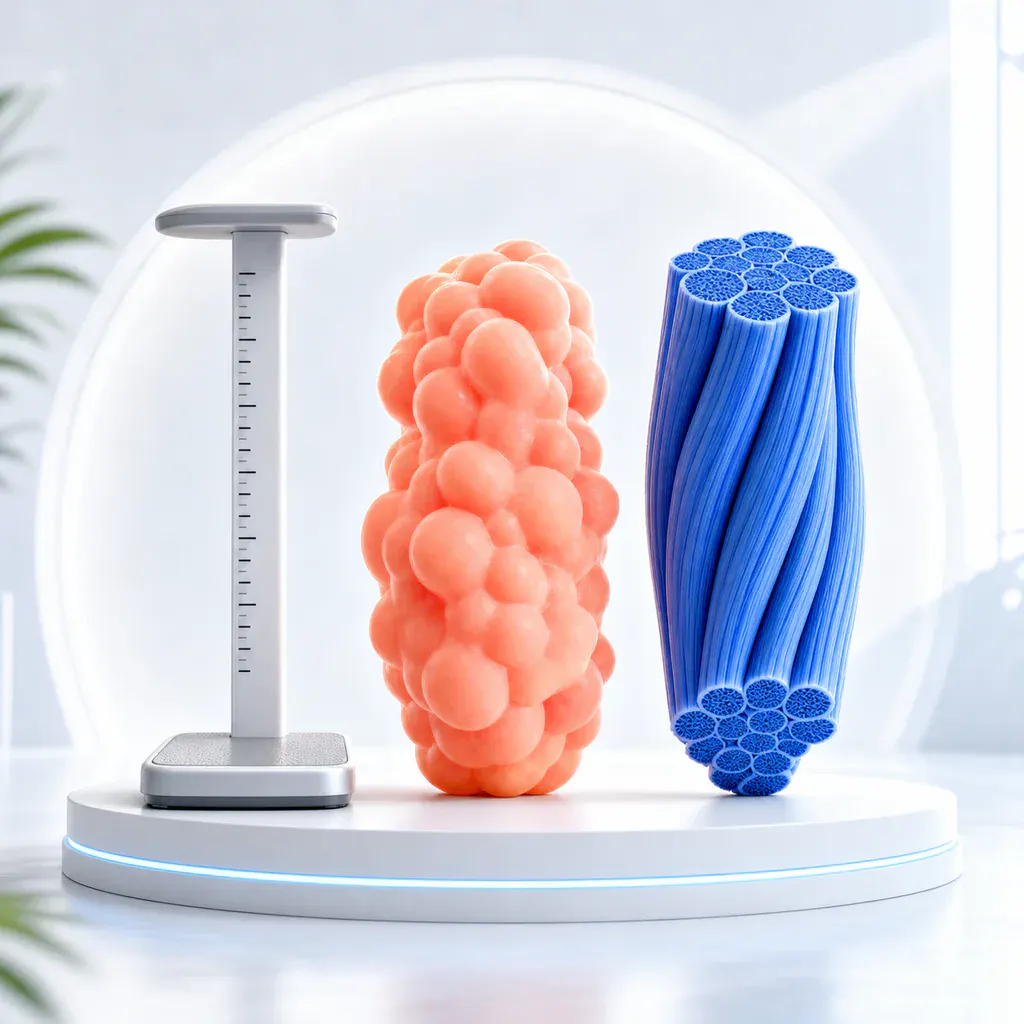
BMI compares body weight with height. It is simple, quick and can be useful as rough population-level orientation. The problem starts when BMI is treated as a precise description of body composition.
BMI does not distinguish fat mass, muscle mass, body water, body shape or fat distribution. Two people with the same BMI can have a very different InBody result and a very different practical context.
That is why BMI is a starting point, not the whole answer. It can say that body weight is high or low relative to height, but not what the weight is made of.
Percent body fat says what share of total weight is estimated to be fat. That is already more useful than BMI for many body-shape, fat-loss and training questions.
It is still not a magic number. PBF changes as a ratio, so it can move when fat changes, but also when muscle, water or total weight changes.
Read it next to fat mass in kilograms, skeletal muscle mass and repeated trend.
Muscle mass is the reason a normal scale and BMI often miss the point. Two people can weigh the same, but one may have more skeletal muscle and less fat.
On InBody, SMM is useful next to body fat, body weight and trend. During fat loss, most people want to lower fat while preserving muscle. During muscle gain, it matters whether weight is rising through muscle rather than mostly fat and water.
SMM is still a bioimpedance estimate, so body water and current state matter. Compare repeated measurements under similar conditions.
InBody helps separate fat, muscle and water context, but the result is still based on bioimpedance. Hydration, food, alcohol, training, sauna, illness, sleep, travel and time of day can influence the output.
This matters when comparing with BMI. BMI changes only when body weight changes. InBody shows more layers, but small differences need careful reading.
The best practice is simple: test at a similar time of day, not right after hard training, without a large meal or alcohol before the visit and with a similar hydration routine.
If you want to lose fat, BMI is only a rough direction. The more important question is whether fat mass is decreasing while muscle stays reasonably stable.
If you want to gain muscle, track SMM, segments, total weight, percent body fat and training performance. Higher weight is not automatically bad if it is supported by muscle gain.
If you want a broader health orientation, add waist, visceral fat, blood pressure and medical lab values where relevant. InBody is not a diagnosis, but it is a useful basis for better questions.
According to the World Health Organization's (WHO) classification, BMI is divided, as a rough guide, into several bands linked to health risk. It's worth keeping in mind that BMI only factors in height and weight — it doesn't distinguish how much of your weight is fat versus muscle, so it can be misleading for athletes or people with a higher muscle share.
| Area | BMI (kg/m²) |
|---|---|
| Underweight | < 18.5 |
| Normal weight | 18.5–24.9 |
| Overweight | 25.0–29.9 |
| Obesity class I | 30.0–34.9 |
| Obesity class II | 35.0–39.9 |
| Obesity class III | ≥ 40.0 |
About the measurement
The main page about body composition measurement, result output and the visit.
Values explained
More reading
FAQ
No. BMI is rough orientation by height and weight. Just do not read it as body composition. InBody adds fat, muscle, water and trend.
Yes. BMI does not distinguish whether higher weight is mostly fat, muscle or other fat-free mass.
Track both together. Each value alone can be misleading without water, total weight and trend.
Not necessarily. BMI falls when body weight falls, but it does not say whether the loss was fat, water or muscle.
Sources
InBody 970 / 970S in Prague helps distinguish whether the change is mainly fat, muscle, water or just scale weight. It is most useful when repeated under similar conditions.