Is quick weight loss always bad?
Not always, but it deserves context. If a quick drop is mostly water and food volume, it may not mean much. If muscle mass is falling repeatedly, the plan may need adjustment.
During weight loss, the scale can move in the right direction while the body composition story is weaker. InBody helps show whether the reduction is mainly fat, or whether muscle mass and water are doing more of the work than you would like.
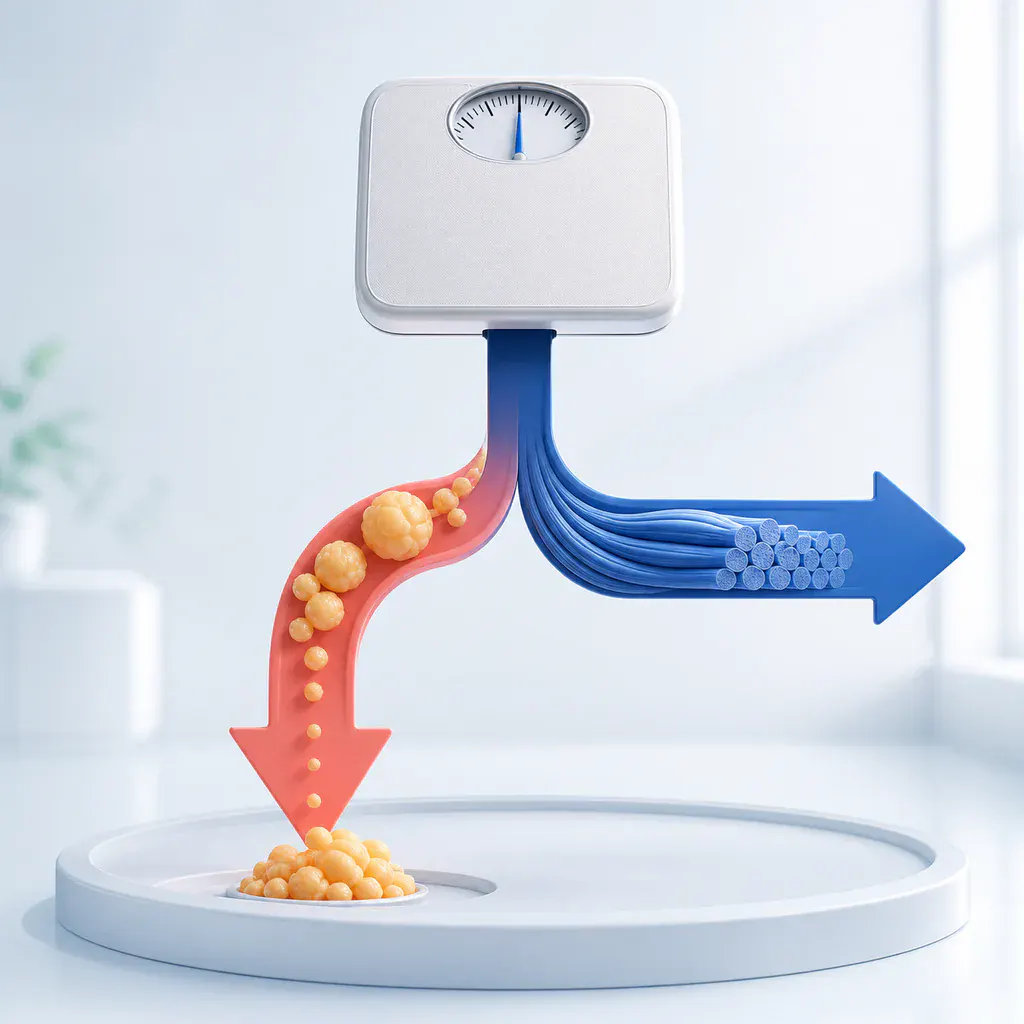
A lower scale number does not automatically mean better fat loss. Weight can drop through fat, water, glycogen, food volume and sometimes muscle mass.
For most people, the useful goal is not just lower weight, but lower fat while preserving as much muscle mass as reasonably possible.
InBody helps by showing body fat mass, percent body fat, skeletal muscle mass, water and repeated history.
A stronger fat-loss trend usually means fat mass is decreasing while skeletal muscle mass stays relatively stable. Percent body fat may fall, waist may improve and the result makes sense across several comparable visits.
If weight drops quickly but SMM drops too, the plan may be too aggressive, recovery may be weak or the result may be distorted by water. One result does not prove it, but the pattern is worth watching.
If weight barely changes but fat goes down and muscle stays stable or improves, that can be a very good body-composition shift.
Water and glycogen can change quickly, especially with changes in carbohydrate intake, salt, training, alcohol, sauna, sleep or illness. That can make lean mass or percentages look different even when fat did not change much.
This is why a single weigh-in or single InBody result can mislead. Comparable preparation and repeated measurements make the trend clearer.
If a result looks strange, check the days before the test before changing the whole plan.
InBody does not evaluate your diet or health as a whole. It can show whether fat, muscle and water are moving in a useful direction over time.
If fat is not moving, muscle is falling or the result repeatedly looks worse than expected, use it as a reason to adjust the broader plan with a qualified trainer, nutrition professional or healthcare provider when appropriate.
The best use is practical: repeat the measurement after a sensible interval and read the direction, not just one sheet.
More people are now losing weight with the support of GLP-1 medications such as semaglutide (Ozempic, Wegovy) or tirzepatide (Mounjaro). The weight loss tends to be faster and larger than with diet alone, which is exactly why it is worth checking what that loss is actually made of — mostly fat, or fat together with muscle.
A fast drop in food intake without enough protein or strength training gives the body less reason to spare muscle. A regular scale cannot show that, since it only shows one falling number. InBody measures fat mass and muscle mass separately, so you can see whether skeletal muscle mass stays roughly stable, or drops alongside fat faster than you would want.
This topic is covered in more depth in a dedicated article on GLP-1 medication and muscle mass, including practical ways to lower the risk of losing muscle. Any change to dosing or the treatment itself is always a decision for the prescribing doctor — InBody does not evaluate or manage the treatment, it only adds a view of what is actually changing in the body during weight loss.
About the measurement
The main page about body composition measurement, result output and the visit.
Values explained
More reading
FAQ
Not always, but it deserves context. If a quick drop is mostly water and food volume, it may not mean much. If muscle mass is falling repeatedly, the plan may need adjustment.
It can estimate muscle and fat-free mass and show trend. One result is not enough, but repeated comparable measurements can be very useful.
Track fat mass, percent body fat, skeletal muscle mass, body water, waist and how the values change across comparable visits.
A regular scale cannot tell you, since it only shows total weight change. InBody measures fat mass and muscle mass separately, so repeated measurements show whether skeletal muscle mass stays stable or drops alongside fat more than it should. The dedicated article on GLP-1 medication and muscle mass covers this in more depth, while questions about dosing or the treatment itself always belong to your doctor.
Strength training combined with adequate protein generally lowers the risk that weight loss also takes muscle, since the body then has less reason to break it down. The right training and nutrition setup is best worked out with a trainer or nutrition professional, ideally in line with guidance from the doctor who prescribed the treatment.
InBody in Prague helps you see whether weight loss is mostly fat or whether you are also losing what you would rather keep. It is strongest when read as trend under similar conditions.