Back to the results guide

Segmental analysis: five body regions, several different layers

A segmental result is not one “muscle map”. For each arm, leg and the trunk, it combines several views: lean mass, fat, water, water distribution and electrical phase angle. Only their relationship can show what may sit behind a difference between segments.

Where to find it: The Segmental Lean Analysis and Segmental Fat Analysis sections.

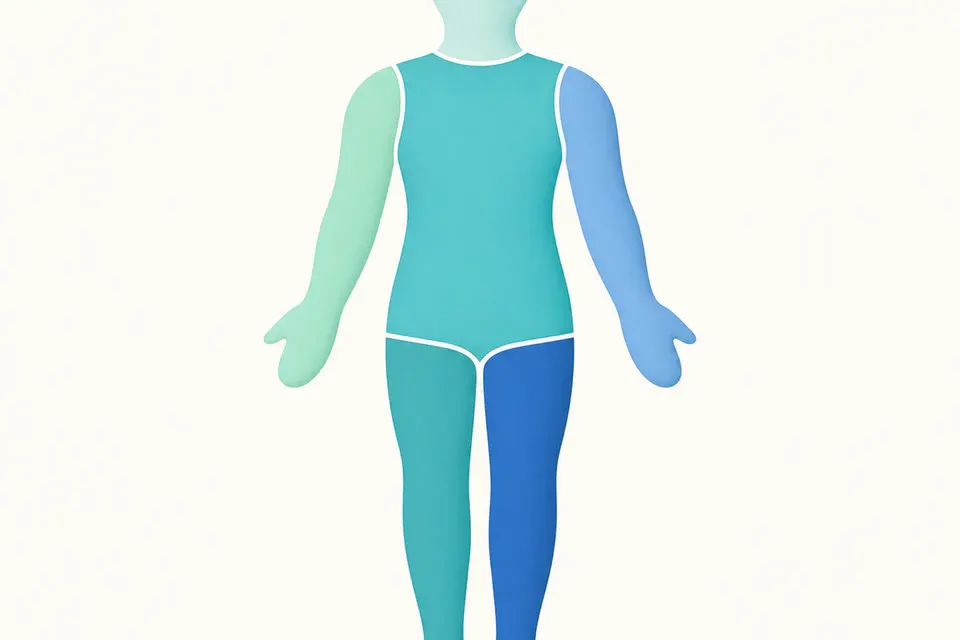
Illustration of a body divided into arms, trunk and legs

01

One body silhouette, five different questions

The same regions recur across several sheets, but each layer uses a different quantity and a different comparison.

InBody divides the body into the right arm, left arm, trunk, right leg and left leg. For those five regions it can show lean mass and fat in kilograms, water in litres, ECW/TBW as a unitless ratio and phase angle in degrees. These values cannot be collapsed into one “segmental score”.

A practical reading order runs from tissue amount through water context to the electrical measure. If lean mass in one leg changes, for example, water and ECW/TBW help assess whether part of the difference may be short term. Phase angle adds another view but does not by itself establish segment quality or health.

  • Lean mass: modelled non-fat tissue amount.
  • Fat: estimated fat mass in the region.
  • Water and ECW/TBW: water amount and its relative distribution.
  • Phase angle: an electrical quantity, not a health score.
R armL armTrunkR legL leg
Muscle
Fat
Water
ECW/TBW
Phase angle
Teaching diagram — these are not your measured data.

02

Lean mass and fat do not use the same percentage

Kilograms show estimated amount in the segment. Percentages for segmental lean mass and fat compare against a reference rather than against each other.

Segmental lean mass has two views on the result: a comparison with the amount expected for ideal weight and an assessment of whether the segment is sufficient for the current body weight. Segmental fat instead shows kilograms and a percentage relative to the fat reference for that segment.

One hundred per cent is therefore neither the share of fat or muscle inside the arm nor a ceiling that must not be exceeded. When comparing sides, inspect kilograms, the type of percentage reference and the longer trend together. A small difference at one visit does not establish functional weakness or identify the cause of asymmetry.

  • Kilograms and percentages in segmental analysis are not interchangeable.
  • Segmental fat percentage is not the percentage of that segment’s own weight.
  • Lean mass is not identical to pure skeletal muscle mass.
  • For arm function, add a direct grip-strength measurement when available.

03

Water can change the lean-mass picture

More water in a segment can raise estimated lean mass without the same increase in new tissue.

Segmental body water shows litres in each body region. Segmental ECW/TBW describes how much of that water is outside cells. The two must be read together: more water with a stable ratio is a different pattern from a relative shift towards extracellular water.

If one side is unexpectedly high or changes quickly, check water, ECW/TBW and measurement conditions before calling the difference muscle gain. The result does not establish oedema or another medical condition and does not identify the cause.

  • Segmental water = amount in litres.
  • Segmental ECW/TBW = water distribution in that region.
  • More water can overstate segmental lean mass.
  • Time of day, recent activity and posture before measurement can especially affect lower-limb results.

04

Phase angle is electrical context, not a segment grade

Segmental phase angle is derived from resistance and reactance in the same body region and is reported at several frequencies.

Phase angle is not another kilogram estimate. It is an electrical quantity in degrees calculated from measured resistance and reactance. A trend comparison must keep the same segment, frequency, device and measurement conditions as consistent as possible.

The manufacturer manual does not provide a universal reference range for segmental phase angle. Do not compare the value with an arbitrary table from another device or population, and do not treat it as a health or “cell quality” score. Its most useful role is a personal repeated trend read alongside water and tissue estimates.

  • Compare the same frequency and the same body region.
  • A value in degrees is neither a percentage nor a score.
  • The manufacturer gives no universal threshold for segmental phase angle.
  • Interpret trend direction alongside water and lean mass, not in isolation.

05

A side-to-side difference is an observation, not a diagnosis

Asymmetry is more useful when checked across several layers and visits rather than inferred from one deviation.

First verify orientation: right and left on the result are named from the measured person’s perspective. Then check whether the difference appears in one measure only or across lean mass, fat, water and their trends.

A repeated difference can relate to side dominance, an asymmetric sport, previous injury, unequal loading or water status. Bioimpedance cannot identify the cause. If a difference is new, large, accompanied by symptoms or changing quickly, interpretation of possible medical causes belongs with a qualified professional.

  • Verify the correct side and comparable measurement conditions.
  • Look for agreement across several layers, not one isolated deviation.
  • Follow several visits; a small one-off change can reflect measurement variability.
  • Muscle function cannot be determined from kilograms of lean mass alone.

Verified sources for segmental analysis

The meaning of each segmental layer comes from the InBody 970 interpretation manual and manufacturer validation material. Peer-reviewed sources on bioimpedance and phase angle add the limitations needed for single results and cross-device comparisons.

Content reviewed · 2026-07-26

Explanations make the most sense alongside your own trend.

The public guide is open to everyone. The client portal adds your own value, history and the context of a specific measurement.